
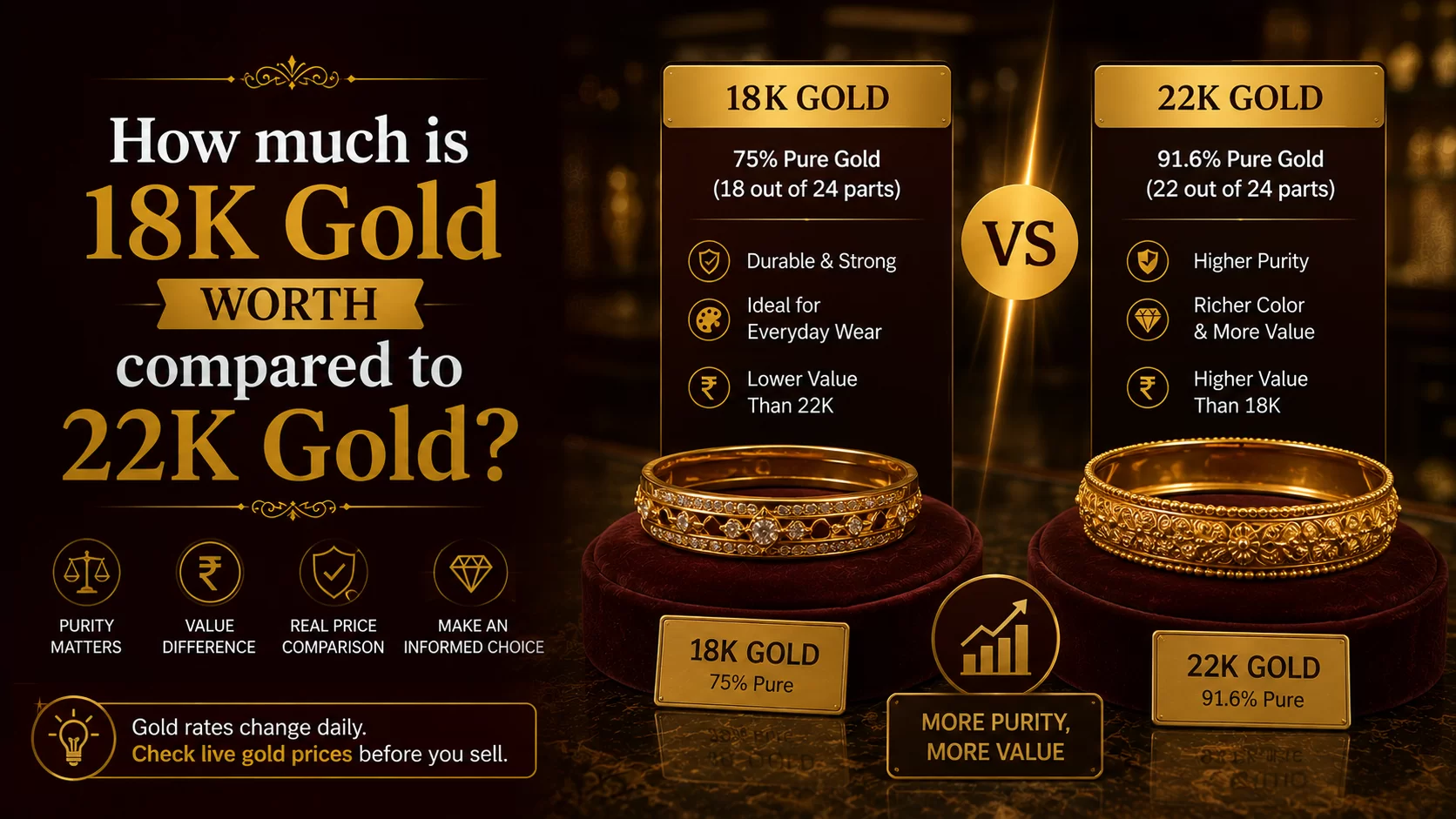
People often assume that the age or design of a piece influences its resale value, but when it comes to gold buying, the purity and net weight are almost all that matters. Understanding the relationship between karat ratings and how they translate into actual payments will help you set realistic expectations before you visit any buyer. If you are planning to sell old gold jewellery in Kolkata and your collection includes pieces of different purities, the value difference between them can be substantial.
What Karat Ratings Actually Mean
Gold in its purest form is 24 karats, which represents 99.9 percent pure gold. Most jewellery is not made from pure gold because the metal is too soft in that form to hold detailed settings or withstand regular wear. Alloying gold with other metals, typically silver, copper, zinc, or palladium, adds durability and makes it suitable for intricate jewellery design.
The karat number tells you how many parts out of 24 are pure gold. A 22 karat piece contains 22 parts gold and 2 parts other metals, giving a purity of approximately 91.6 percent. An 18 karat piece contains 18 parts gold and 6 parts other metals, representing 75 percent purity. A 14 karat piece is 58.3 percent gold.
In the Indian market, 22 karat is the dominant standard for traditional jewellery, particularly in Kolkata, where elaborate gold ornaments for weddings and festivals are common. 18 karat gold is more widely used in contemporary and diamond-set jewellery, where the harder alloy better holds precious stone settings.
It is also worth knowing that a hallmark on the jewellery, whether the BIS marking on newer pieces or older karat stamps, tells you the declared purity at the time of manufacture. However, this figure should always be confirmed through testing before selling. The actual composition may vary from the stamped figure, particularly on older or imported pieces, and the tested reading is what any reputable buyer will use to calculate your payment.
How the Price Difference Is Calculated
When you sell old gold jewellery in Kolkata, the buyer calculates your payment by multiplying two figures: the net gold weight of your piece, measured in grams, and the per-gram buy rate for the applicable purity on that day. The Kolkata Gold and Diamond Federation publish the daily buy rate for different purities.
To illustrate: if the current buy rate for 22 karat gold is Rs 7,500 per gram and for 18 karat is Rs 6,136 per gram, a 10-gram piece in 22 karat (net gold weight) would yield Rs 75,000, while the same net weight in 18 karat would yield Rs 61,360. The difference is approximately 18 percent for the same physical weight, which corresponds directly to the purity difference between the two standards (91.6 percent versus 75 percent).
This relationship holds regardless of the design, age, or brand of the jewellery. A plain 22 karat bangle and an ornate 22 karat necklace of the same net gold weight will yield the same payment from a gold buyer, because neither design nor aesthetic adds to the gold content.
In practical terms, their respective gold content fixes the per-gram rate difference between 22K and 18K, but how that rate is applied depends on the testing methodology. An accurate XRF reading of an 18K piece will confirm 75 percent gold content precisely; an approximate acid test might read 73 or 77 percent, with corresponding impact on the offer. Accurate testing benefits sellers of both purities.
How Net Weight Is Determined
The distinction between gross and net weight is critical, especially for 18 karat pieces, which are often diamond-set or contain significant non-gold materials. Gross weight is the total weight of the piece. Net weight is what remains after deducting all stones, enamel, thread, and backing materials.
For a heavily studded 18 karat pendant, a large proportion of the gross weight might be stone and setting rather than gold. The buyer will either remove and weigh the stones separately before weighing the metal, or apply a standard deduction based on the visible stone content. A transparent buyer will show you this deduction explicitly so you understand why the net weight differs from what the piece feels like in your hand.
XRF testing confirms the purity figure without the need to melt or damage the piece. This is particularly valuable for jewellery you are unsure about, as it gives an accurate reading of the actual karat level even if no hallmark is present. It is also the fairest method for the seller, since the reading is objective and cannot be adjusted by the buyer after the fact.
Getting the Right Value When Selling Mixed-Purity Collections
If you are selling a collection that includes pieces across different karat ratings, a trustworthy buyer will test and price each category separately, rather than applying a blanket rate to everything. Grouping 22 karat and 18 karat pieces and valuing them at a blended rate usually means the 22 karat pieces are undervalued.
Cash On Old Gold conducts individual XRF testing on each piece, applies the Kolkata Gold and Diamond Federation’s daily buy rate for the relevant purity, and calculates payment based on net gold weight. The process is carried out in front of the seller, with each figure- purity, weight, deductions, and day’s rate- clearly explained before the offer is made.
When you decide to sell old gold jewellery in Kolkata, knowing what drives the price difference between 18K and 22K gives you a useful framework for estimating your collection’s approximate value before you visit. The actual payment will depend on the precise purity readings and net weights determined during testing, but having a rough figure in mind means you can recognise a fair offer when you receive one.
At Cash On Old Gold, we handle mixed-purity collections routinely and ensure that each piece is evaluated on its own merits, so higher-purity jewellery in your collection is priced at the rate it deserves.

0 Comments