
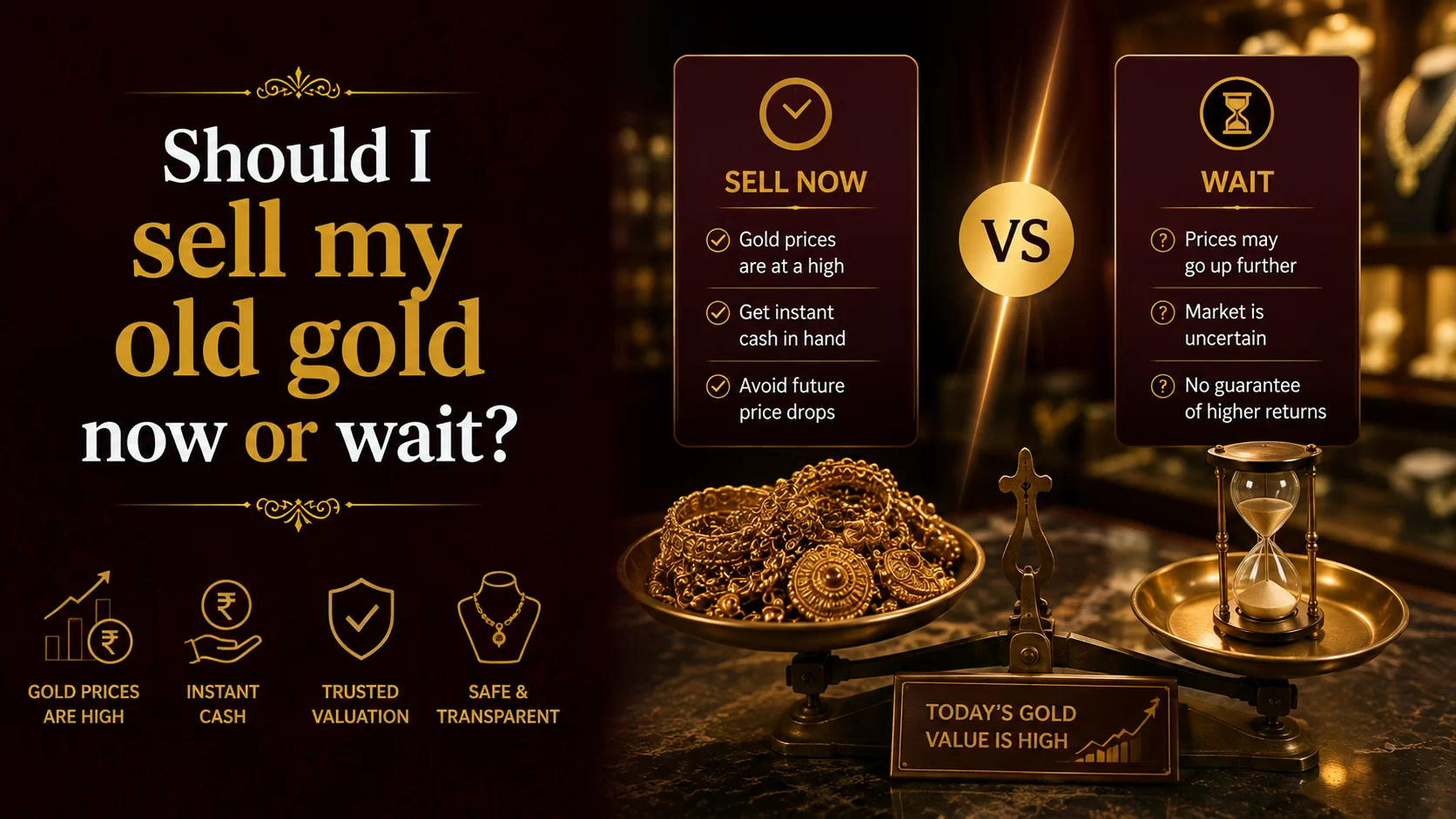
It is one of the most common questions people ask before approaching a gold buyer: is this a good time to sell, or would waiting a few months yield a better return? The honest answer is that reliably timing the gold market is difficult, even for experienced analysts. But there are practical factors you can evaluate to decide whether selling now makes sense for your situation, rather than waiting on a price movement that may or may not materialise.
The question of timing often matters less than people expect, because the difference between a good week and a slightly better week for gold prices is usually small relative to the total payment on a modest quantity of jewellery. The more meaningful variables are the accuracy of the testing, the honesty of the weight deductions, and whether the buyer is pricing to the current federation rate or applying their own margin on top of it.
How Gold Prices Move and What Drives Them
Gold is priced globally in US dollars per troy ounce. That price reflects a wide range of economic signals: inflation data, central bank policy, geopolitical uncertainty, and the relative strength of the dollar. When uncertainty rises, gold typically strengthens, because investors and institutions treat it as a store of value that holds through turbulence. When economic confidence is high and equity markets are performing well, gold demand from investors tends to soften.
In Indian terms, the rupee gold price is the product of the international rate and the INR/USD exchange rate, adjusted for import duties and local supply dynamics. This means that even when global gold prices are flat, a weakening rupee can push local prices higher, while a strengthening rupee can bring them down even if global prices are rising. The Kolkata Gold and Diamond Federation publishes updated buy rates for the city each day, and these directly reflect current market conditions.
Attempting to predict the precise peak before you sell old gold jewellery is the same challenge as timing any commodity market, and the risk of waiting for a price that never comes is just as real as the upside of catching a rally. Most financial planners treat gold as a long-term holding, not as an asset to trade around short-term movements, and that perspective applies equally when deciding when to liquidate it.
When Selling Now Is the Right Decision
There are circumstances where waiting clearly does not serve your interest. If you have a near-term financial need, holding gold for a potential price gain while carrying a high-interest loan or deferring an important expense is a trade-off that rarely favours waiting. The interest cost of borrowing over the same period almost always exceeds a modest price improvement in gold.
Jewellery that is broken, badly tarnished, or stored in ways that risk further damage also has no reason to wait. Condition does not affect the gold content of a piece, but leaving damaged jewellery in uncertain storage when you could be converting it into usable cash is simply an opportunity cost.
Similarly, if you have old jewellery from changing fashion cycles that you are unlikely to wear again, the relevant comparison is not between today’s price and a hoped-for higher price. Still, between converting it now and continuing to store an asset you are not using. Sell old gold jewellery that has no active purpose, and the cash can start working for you immediately.
When Waiting Could Be Justified
If you have no immediate financial requirement and gold has recently experienced a short-term dip due to temporary factors, waiting a few weeks to see if prices recover to a recent average is a defensible approach. This is different from speculating on sustained price growth, which requires a level of market analysis that most sellers reasonably do not want to engage in.
Similarly, if you are in the process of evaluating multiple buyers and have not yet identified one you are confident in, taking the time to compare offers and processes is worthwhile. A difference in evaluation methodology between buyers can result in a meaningful difference in your final payment, independent of where the gold price happens to be that day.
One underappreciated point is that the quality of the buyer has a larger practical impact on your final receipt than modest price movements over a few weeks. A buyer who uses less accurate testing or applies wider deductions can effectively reduce your payment by more than a short-term gold price change would have gained you. Choosing the right buyer carefully, regardless of timing, is often the more consequential decision.
Making the Decision With Accuracy
Whatever timing you choose, the quality of the buyer matters as much as the timing itself. A buyer who undervalues purity or calculates from gross rather than net weight can reduce your payment regardless of whether gold prices are high or low on the day. Accurate testing, transparent net weight deductions, and pricing anchored to the published federation rate are what ensure you receive the fair value of the gold you are selling.
Cash On Old Gold provides an in-person, fully transparent evaluation using XRF machine testing. The offer is based on net gold weight and the Kolkata Gold and Diamond Federation’s prevailing buy rate, so the price you receive reflects actual market conditions rather than an estimate. Payment is available immediately in cash, NEFT, RTGS, or cheque.
If you are ready to sell old gold jewellery and want to be certain the evaluation is accurate, visiting a trusted buyer with the right equipment gives you the clearest picture of what your gold is worth right now. That is the best starting point for deciding whether to sell today or keep tracking the market a little longer. Cash On Old Gold makes it straightforward to get an accurate, obligation-free valuation whenever you are ready.

0 Comments